Placing your first order? Use the code FIRST10 for 10% off on the checkout page.
Close message
Placing your first order? Use the code FIRST10 for 10% off on the checkout page.
Close message

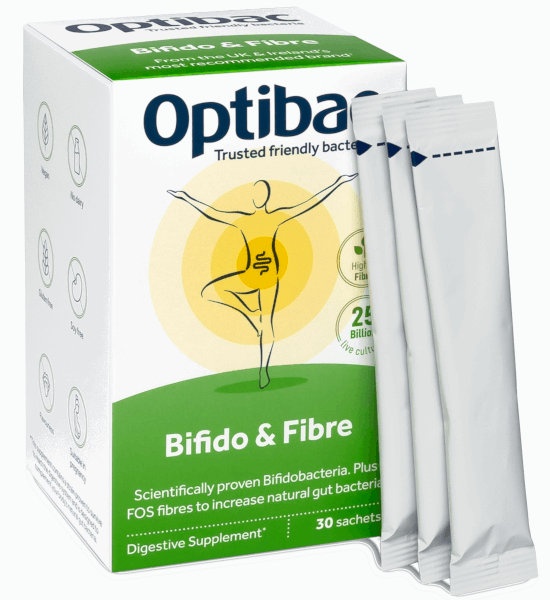
OptiBac Probiotics Bifidobacterium & Fibre (helps maintain regularity) 30 sachets

Price £22.99
Discounts
2+
10.00%
Related Products
Constipation is defined by having hard, dry stools, and difficulty in passing bowel movements. A large global study of 13,900 individuals concluded that 12% of people worldwide suffer from constipation. Constipation affects women more than men, and in particular infants, pregnant women, and the elderly.
Introducing Optibac Bifidobacterium & Fibre 30 Sachets With Bifidobacterium lactis BB-12® (formerly ‘For Maintaining Regularity’)
Scientific research shows that Bifidobacterium Lactis BB-12 can help in both long-term & short-term constipation (see sources below).
Having an imbalance of probiotic (good) and pathogenic (bad) bacteria in the intestines can lead to various health conditions including sluggish bowels, bloating and constipation. Supplementing your diet withprobiotics can help to maintain a healthy balance of good bacteria over bad, thereby supporting your digestive system. OptiBac Probiotics Bifidobacterium & Fibre provides 5 billion live microorganisms of the probiotic Bifidobacterium lactis BB-12®per sachet, as well as the prebiotic fibre fructooligosaccharides, and has been scientifically researched to help maintain regular bowel movements. It contains no added flavourings & colourings and is gentle enough for children (from 1 year onwards), for pregnant & breastfeeding mothers, and for the elderly. Furthermore this supplement is suitable for vegans, vegetarians, and is free from gluten and yeast.
Which size should I buy?
The following informatiom supplied by the manufacturers may help you decide which one to go for
The 10 sachet size is primarily intended to help with fast relief for acute constipation (short term), and you can take up to 4 per day. Take one every few hours until relief is obtained. (If the prebiotics in it cause gas and wind, you should reduce this dosage, so there is a common sense element with this product. Occasionally super sensitive people should only take half per day). Once you respond, you can finish off the pack taking one per day.
The 30 sachet size is better value for those chronic constipation, designed to be taken long term if necessary. One sachet per day is recommended, preferably with or after an evening meal. You can still take one every few hours to begin with if you are constipated at the time of initial useage as with the 10 sachet size, but after that one per day should be sufficient.
Directions
Adults and children (from 1 year and up)
- Take 1 sachet a day to maintain regularity long-term
- Or take as and when desired, and up to 4 sachets a day.
Mix contents of sachet with cold drinks or food, or, if in a hurry, contents of sachet can be poured directly into your mouth.
Drink plenty of water with this probiotic & prebiotic supplement.
Safety
It is not recommended to give probiotics to severely immunosuppressed patients, infants with short bowel syndrome (SBS), post cardiac surgery patients, patients with pancreatitis, patients in the Intensive Care Unit (ICU) or patients with blood in the stool unless under a doctor’s care.
Active Ingredients per sachet
Probiotic: Bifidobacterium lactis BB-12® (5 billion live microorganisms) & Prebiotic: Fructooligosaccharides (4 grams)
Full Ingredients per sachet
Prebiotic: Fructooligosaccharides (FOS 4g); Standardised culture (Bifidobacterium lactis BB-12®, fructose); anticaking agent: silicon dioxide.
Note: The relatively high dose of prebiotics in this supplement may initially cause some gas or bloating; this is a positive indication that the prebiotics are encouraging the growth of the probiotics in the intestines. If symptoms continue for more than 3 – 4 days, consider reducing your dose of ‘For maintaining regularity’ before gradually building it up again.
Storage
Like the rest of the range, 'Bifidobacterium & Fibre' does not require refrigeration.
Store out of direct sunlight.
Sources:
1) Murakami et al. (2006) Safety and effect of yoghurt containing BB-12 on improvement of defacation and faecal microflora in healthy volunteers.J Nutritional Food, 9:15-26.
2) Uchida et al. (2005) Effect of fermented milk containing bifidobacterium lactis BB-12 on stool frequency, defacation, faecal microbiota and safety of excessive ingestion in healthy female students. Journal of Nutritional Food, 8(1):39-51.
3) Shioya et al (2000) Effect of fermented milk containing Bifidobacterium lactis FK 120 on the fecal flora and fecal properties in healthy female volunteers. Journal of Nutritional food 3 (1), 7 – 18.
4) Shioya et al (2000) Effect of fermented milk containing Bifidobacterium lactis FK 120 on the fecal flora, with special reference to Bifidobacterium species, and the fecal properties in healthy volunteers. Journal of Nutritional Food 3 (1), 19-32.
5) Nishida et al. (2004) Effect of yoghurt containing Bifidobacterium lactis BB-12 on improvement of defacation and fecal microflora of healthy female adults. Milk Science, 53, 71-80.
6) Pitkala et al. (2007) Fermented Cereal with specific Bifidobacteria normalizes bowel movements in elderly nursing home residents. Journal of Nutrition, Health & Ageing, 11(4) : 305-11.
Ingredients Label (Click on image to expand)